


Can Pyrolysis Gas be Used as Fuel in Biochar Production?
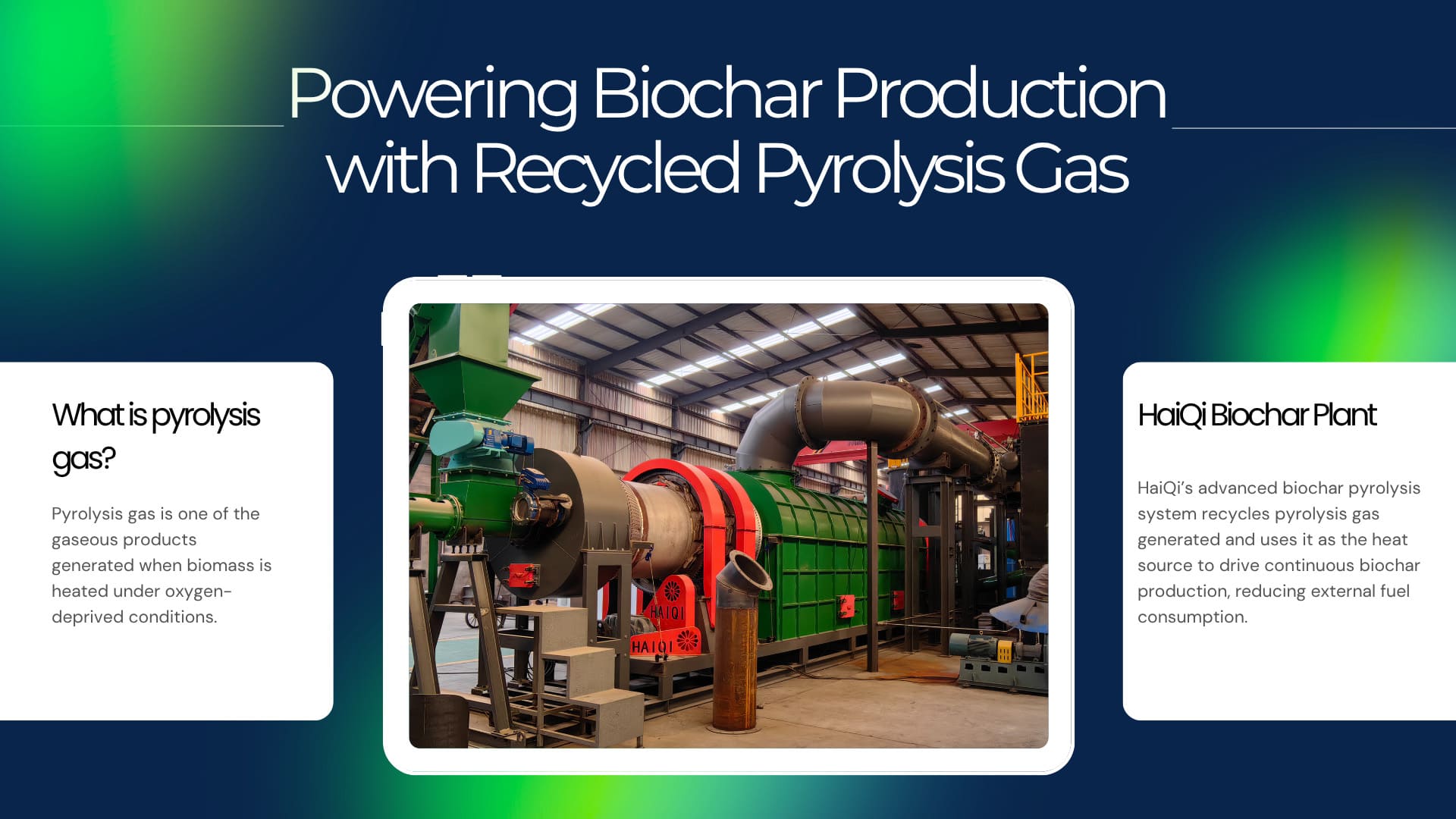
Yes. In many modern pyrolysis systems, the gas generated during pyrolysis can be recovered, purified, and reused as fuel to provide some of the thermal energy required for the biochar production process.
This is one of the most common methods for improving the energy efficiency of continuous biomass pyrolysis units. Well-designed systems are capable of recovering the energy from pyrolysis gas and reusing it in the process, rather than treating it as a waste stream. Once the system reaches a stable operating state, the combustible gas produced from the biomass can be fed into a combustion chamber to generate the heat required for pyrolysis.
When biomass (such as wood residues, agricultural residues, bamboo, seashells, or other suitable organic materials) is heated, the biomass undergoes pyrolysis, producing a variety of products that typically include: biochar, pyrolysis gas, condensable steam and liquids, and other volatile compounds.
The gas may contain combustible components, such as carbon monoxide, hydrogen, methane, and other light hydrocarbons. Therefore, it may harbor useful chemical energy. Rather than allowing this gas to be released into the atmosphere, an integrated pyrolysis system can recover it and utilize its energy to support thermal processes. This creates an important internal energy cycle:
Biomass → Pyrolysis → Pyrolysis Gas → Gas Purification → Combustion → Thermal Energy → Pyrolysis
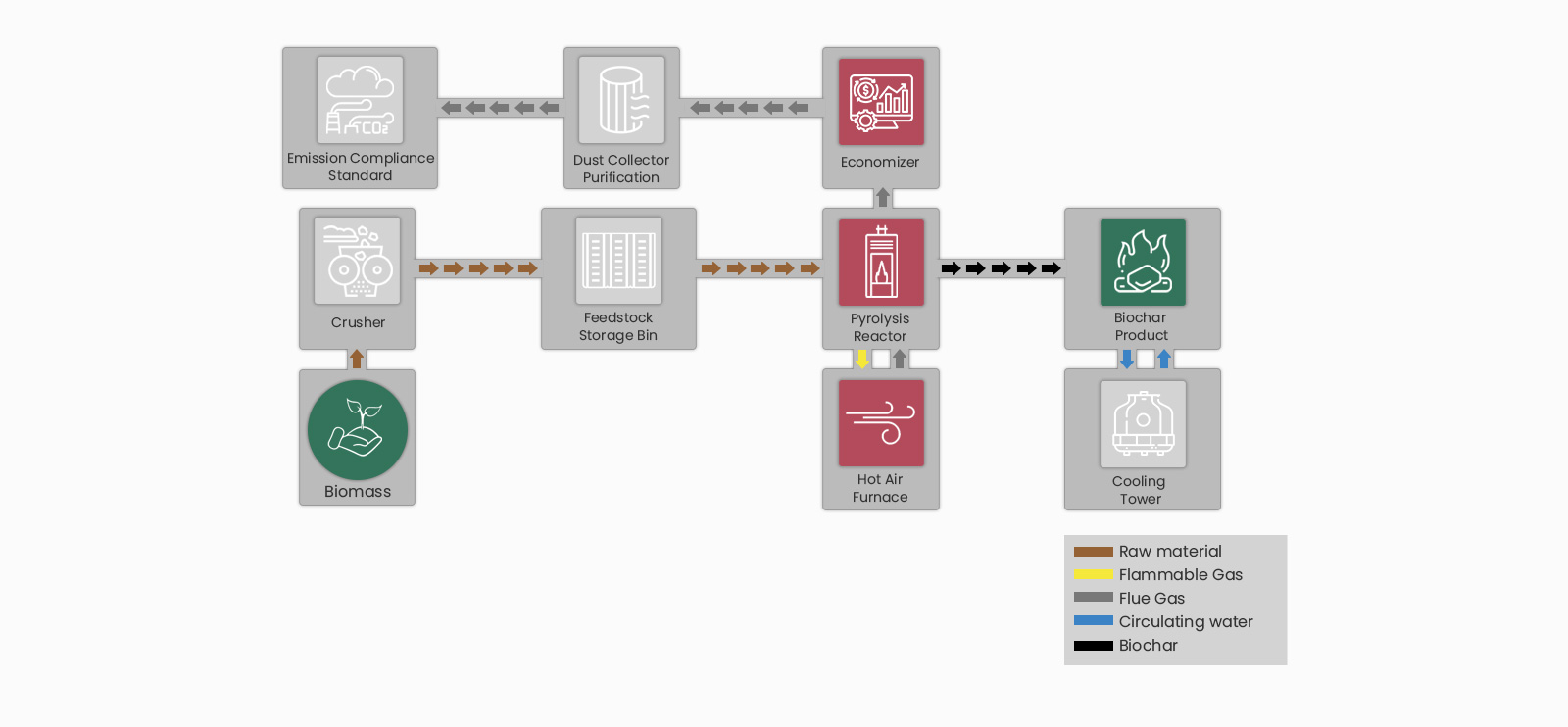
In many biomass pyrolysis plants, the purpose of this cycle is to recover the thermal energy contained in the gas and use it directly in the pyrolysis process.
In other words:
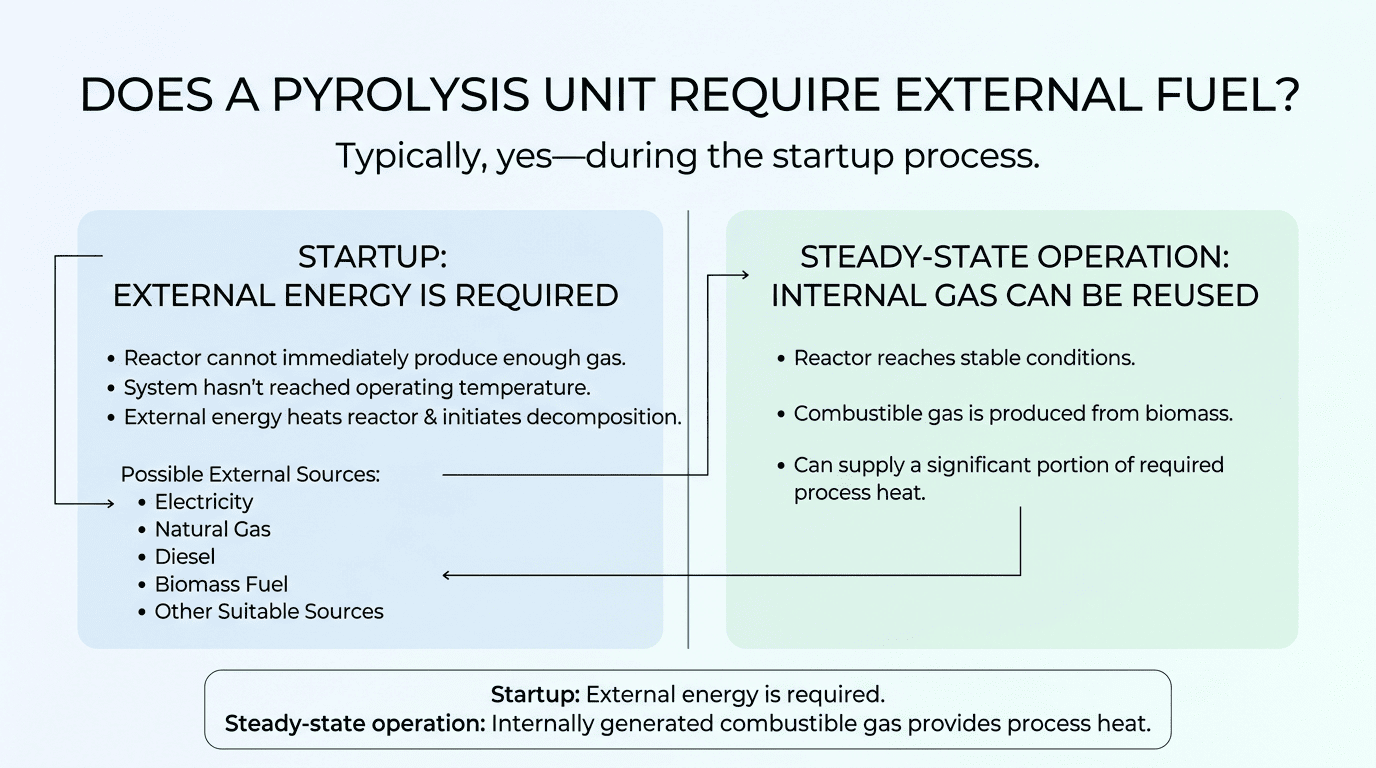
Startup: External energy is required.
Steady-state operation: Internally generated combustible gas can be reused to provide process heat.
Shutdown: The system must be safely shut down in accordance with the plant's operating procedures.
However, electricity generation requires additional equipment and introduces further technical considerations. For example, gas used in internal combustion engines typically must meet higher purity and stability requirements than gas used directly in a properly designed combustion system.
Therefore, the question should not simply be: "Can pyrolysis gas be used to generate electricity?”
A better question is: What is the most appropriate energy utilization method for this specific project?
For projects with high internal heating demands, direct thermal energy recovery may be the most straightforward approach.
For projects with high electricity demands or existing combined heat and power (CHP) applications, electricity generation may be more attractive.
This involves the interaction of the following aspects:
Feedstock → Reactor → Gas Generation → Gas Treatment → Combustion → Heat Transfer → Pyrolysis
A weakness in any single link can affect other parts of the system. For example, excessive moisture in the feedstock increases drying requirements. Higher heat demand reduces the residual energy available for other purposes. Poor gas regulation affects combustion stability. Heat loss increases the amount of fuel required. Therefore, it is insufficient to evaluate a pyrolysis plant based solely on reactor capacity. The entire energy system must be taken into account.
1. How is pyrolysis gas collected?
The system should have a defined gas pathway rather than relying on uncontrolled venting.
2. How is the gas treated?
The supplier should be able to explain how particulates, condensables, tar, and other relevant components are handled.
3. Where is the gas used?
Is it used for direct process heating, drying, steam generation, cogeneration, power generation, or other applications?
4. What happens during startup?
The system should clearly define the external energy required before stable pyrolysis gas production begins.
5. What happens when natural gas production fluctuates?
Commercial systems require appropriate control and safety measures to address variations in gas production.
6. How is excess heat recovered?
If the heat generated by the power plant exceeds the heat required by the reactor, understanding available heat recovery options helps determine the project's overall energy efficiency.
7. What feedstock assumptions are used?
Energy performance should be evaluated based on actual feedstock conditions (particularly moisture content and composition).
The first step is to convert biomass into stable, carbon-rich material.
The second is to carry out the conversion process efficiently while maintaining the required environmental and carbon accounting conditions.
During steady-state operation, utilizing internally generated pyrolysis gas as process heat helps reduce the need for external fossil fuel inputs. However, the mere presence of internal energy recovery does not, in and of itself, determine whether a project qualifies for carbon removal credits.
Carbon removal accounting must consider the entire project boundary, including feedstock sources, processing, energy consumption, emissions, biochar characteristics, transportation, application, and other relevant factors, depending on the applicable methodology. Therefore, pyrolysis gas utilization is an integral part of project design rather than a standalone carbon removal claim.
For project developers, the most effective approach is to evaluate systems based on actual operating conditions rather than on a single set of specifications.
Key questions include:
This is one of the most common methods for improving the energy efficiency of continuous biomass pyrolysis units. Well-designed systems are capable of recovering the energy from pyrolysis gas and reusing it in the process, rather than treating it as a waste stream. Once the system reaches a stable operating state, the combustible gas produced from the biomass can be fed into a combustion chamber to generate the heat required for pyrolysis.
What is Pyrolysis Gas?
Pyrolysis gas—sometimes referred to as pyrolysis syngas or generator gas, depending on the process and gas composition—is one of the gaseous products generated when biomass is heated under oxygen-deprived conditions.When biomass (such as wood residues, agricultural residues, bamboo, seashells, or other suitable organic materials) is heated, the biomass undergoes pyrolysis, producing a variety of products that typically include: biochar, pyrolysis gas, condensable steam and liquids, and other volatile compounds.
The gas may contain combustible components, such as carbon monoxide, hydrogen, methane, and other light hydrocarbons. Therefore, it may harbor useful chemical energy. Rather than allowing this gas to be released into the atmosphere, an integrated pyrolysis system can recover it and utilize its energy to support thermal processes. This creates an important internal energy cycle:
Biomass → Pyrolysis → Pyrolysis Gas → Gas Purification → Combustion → Thermal Energy → Pyrolysis
In many biomass pyrolysis plants, the purpose of this cycle is to recover the thermal energy contained in the gas and use it directly in the pyrolysis process.
How Does the Energy Recovery Process Work?
Biomass Enters the Pyrolysis System
Pre-prepared biomass is continuously fed into the pyrolysis reactor. Feedstock preparation is critical because moisture content, particle size, density, and consistency all affect heat demand and system stability. For example, wet biomass requires additional energy because a portion of the heat must first be used to evaporate the moisture.Biomass is Heated in an Oxygen-Free Environment
As the temperature of the biomass rises, pyrolysis begins. The organic components of the biomass decompose, producing solids, gases, and condensable products. The gas generated during this process contains combustible compounds.Pyrolysis Gas Collection/Recovery
The pyrolysis system does not allow the gas to escape but instead collects it through controlled gas pathways. At this stage, depending on the feedstock and system design, the gas may contain dust, condensable compounds, tar, water vapor, and other impurities. Therefore, gas treatment involves more than simply connecting a pipe from the reactor to a burner.Treatment or Conditioning of Pyrolysis Gas
The gas may require appropriate cleaning, cooling, separation, or conditioning before it can be reused. Specific treatment requirements depend on the gas composition and its intended use. Pyrolysis systems designed specifically for direct thermal energy recovery may have different requirements than those intended to power internal combustion engines or other power generation units. This distinction is important because higher gas quality standards apply when the gas is used in precision equipment such as engines.Combustion of Pyrolysis Gas and Heat Recirculation
After proper treatment, combustible gases can be fed into a combustion chamber or burner. The chemical energy contained in the gas is converted into thermal energy. The generated heat is then transferred back to the pyrolysis system. In an indirect heating configuration, the heat from combustion is transferred via the reactor’s heating surfaces or other heat transfer systems without directly mixing the combustion gases with the biomass undergoing pyrolysis. In this way, the gas produced by the process can serve as an internal energy source for the process itself.Does a Pyrolysis Unit Require External Fuel?
Typically, yes—during the startup process. The pyrolysis reactor cannot immediately produce enough combustible gas to heat itself. During startup, the pyrolysis system has not yet reached operating temperature. Therefore, external energy may be required to heat the reactor and initiate the thermal decomposition of the biomass. Depending on the plant design, startup energy can come from electricity, natural gas, diesel, biomass fuel, or other suitable external sources. Once the reactor reaches stable operating conditions, the combustible gas produced from the biomass can supply a significant portion of the heat required for the process.In other words:
Startup: External energy is required.
Steady-state operation: Internally generated combustible gas can be reused to provide process heat.
Shutdown: The system must be safely shut down in accordance with the plant's operating procedures.
Can Pyrolysis Gas Provide All the Heat Required for Biochar Pyrolysis?
This may be possible in certain system configurations, but it is not always the case. Whether pyrolysis gas can provide all the required process heat depends on the overall energy balance. Key factors include:Feedstock Moisture Content
Moisture content is one of the most important factors. Before drying and pyrolyzing biomass, the moisture in the feedstock must first be evaporated, as water evaporation consumes a significant amount of thermal energy. Therefore, high-moisture biomass can significantly increase a plant's heat demand. This is why biomass drying and waste heat recovery can be important components of integrated pyrolysis projects.Feedstock Composition
Different biomass materials contain varying proportions of cellulose, hemicellulose, lignin, ash, and other components. Consequently, their pyrolysis behavior and gas production may differ. Wood residues, agricultural residues, shells, bamboo, and other biomass materials may produce combustible gases in varying quantities and compositions. Therefore, the energy balance should be assessed based on the characteristics of the actual feedstock rather than generic biomass specifications.Particle Size
The size of biomass particles affects heat transfer. If the particles are too large or of inconsistent size, heat may not be transferred evenly throughout the material. This can impact residence time, conversion efficiency, product quality, and overall process stability. Proper feedstock preparation not only helps improve pyrolysis performance but also helps maintain the plant's energy balance.Reactor and Heating Design
Reactor design determines the efficiency with which heat is transferred to the biomass. Even if the feedstock itself has sufficient energy content, an inefficient heating system may require more fuel. Good insulation and a well-designed heat transfer system can minimize unnecessary heat loss.Heat Recovery
Heat generated during the process does not necessarily have to be wasted. Depending on the system configuration, excess heat can be recovered and reused for biomass drying, feedstock preheating, hot water, steam, or other thermal applications. This can improve the project's overall energy efficiency.Can Excess Pyrolysis Gas be Used to Generate Electricity?
It is possible. If the volume of combustible gas produced exceeds the thermal requirements of the pyrolysis process, the excess energy can be utilized for other purposes depending on the gas quality and system configuration. Possible options include electricity generation or combined heat and power (CHP).However, electricity generation requires additional equipment and introduces further technical considerations. For example, gas used in internal combustion engines typically must meet higher purity and stability requirements than gas used directly in a properly designed combustion system.
Therefore, the question should not simply be: "Can pyrolysis gas be used to generate electricity?”
A better question is: What is the most appropriate energy utilization method for this specific project?
For projects with high internal heating demands, direct thermal energy recovery may be the most straightforward approach.
For projects with high electricity demands or existing combined heat and power (CHP) applications, electricity generation may be more attractive.
Why is Gas Management Important for Commercial Pyrolysis?
For small-scale experimental reactors, gas can simply be viewed as a byproduct. For commercial continuous biochar production equipment, it becomes part of the energy management system. The biochar plant must control the entire process—from gas generation to utilization—while maintaining stable operating conditions.This involves the interaction of the following aspects:
Feedstock → Reactor → Gas Generation → Gas Treatment → Combustion → Heat Transfer → Pyrolysis
A weakness in any single link can affect other parts of the system. For example, excessive moisture in the feedstock increases drying requirements. Higher heat demand reduces the residual energy available for other purposes. Poor gas regulation affects combustion stability. Heat loss increases the amount of fuel required. Therefore, it is insufficient to evaluate a pyrolysis plant based solely on reactor capacity. The entire energy system must be taken into account.
When selecting a biomass pyrolysis plant, how should the utilization rate of pyrolysis gas be evaluated?
When evaluating commercial pyrolysis systems, buyers should not simply ask suppliers whether they can "reuse pyrolysis gas." A more comprehensive technical evaluation should address the following questions:1. How is pyrolysis gas collected?
The system should have a defined gas pathway rather than relying on uncontrolled venting.
2. How is the gas treated?
The supplier should be able to explain how particulates, condensables, tar, and other relevant components are handled.
3. Where is the gas used?
Is it used for direct process heating, drying, steam generation, cogeneration, power generation, or other applications?
4. What happens during startup?
The system should clearly define the external energy required before stable pyrolysis gas production begins.
5. What happens when natural gas production fluctuates?
Commercial systems require appropriate control and safety measures to address variations in gas production.
6. How is excess heat recovered?
If the heat generated by the power plant exceeds the heat required by the reactor, understanding available heat recovery options helps determine the project's overall energy efficiency.
7. What feedstock assumptions are used?
Energy performance should be evaluated based on actual feedstock conditions (particularly moisture content and composition).
Utilization of Pyrolysis Gas in Biochar Carbon Removal Projects
Energy management is particularly important for biochar carbon removal projects, as these projects have two concurrent objectives:The first step is to convert biomass into stable, carbon-rich material.
The second is to carry out the conversion process efficiently while maintaining the required environmental and carbon accounting conditions.
During steady-state operation, utilizing internally generated pyrolysis gas as process heat helps reduce the need for external fossil fuel inputs. However, the mere presence of internal energy recovery does not, in and of itself, determine whether a project qualifies for carbon removal credits.
Carbon removal accounting must consider the entire project boundary, including feedstock sources, processing, energy consumption, emissions, biochar characteristics, transportation, application, and other relevant factors, depending on the applicable methodology. Therefore, pyrolysis gas utilization is an integral part of project design rather than a standalone carbon removal claim.
What Should Project Developers Consider When Selecting a Pyrolysis Energy System?
For project developers, the most effective approach is to evaluate systems based on actual operating conditions rather than on a single set of specifications.Key questions include:
- What is the actual moisture content of the feedstock?
- Is the biomass supply stable?
- How much thermal energy is required for drying?
- How much gas will be produced under expected operating conditions?
- How is the gas purified and utilized?
- What external energy is required during startup?
- How is excess heat recovered?
- How are gas and heat flows monitored during continuous operation?
Next Article: