

Rotary Kiln vs. Screw-Type Biochar Pyrolysis Equipment: Which Is Right for Your Project?
Biochar pyrolysis equipment comes in various reactor configurations, but screw-type reactors and rotary kilns are the two most common choices for continuous biomass pyrolysis. When evaluating these systems, buyers often focus on the reactor itself and ask a simple question: what is the difference between a screw-type pyrolysis reactor and a rotary kiln?
The answer begins with how the biomass moves within the reactor. In a screw-type system, a rotating screw conveyor transports the biomass through a stationary reaction chamber. In contrast, with a rotary kiln, the reactor itself rotates, causing the biomass to move within the cylindrical chamber as the kiln turns.
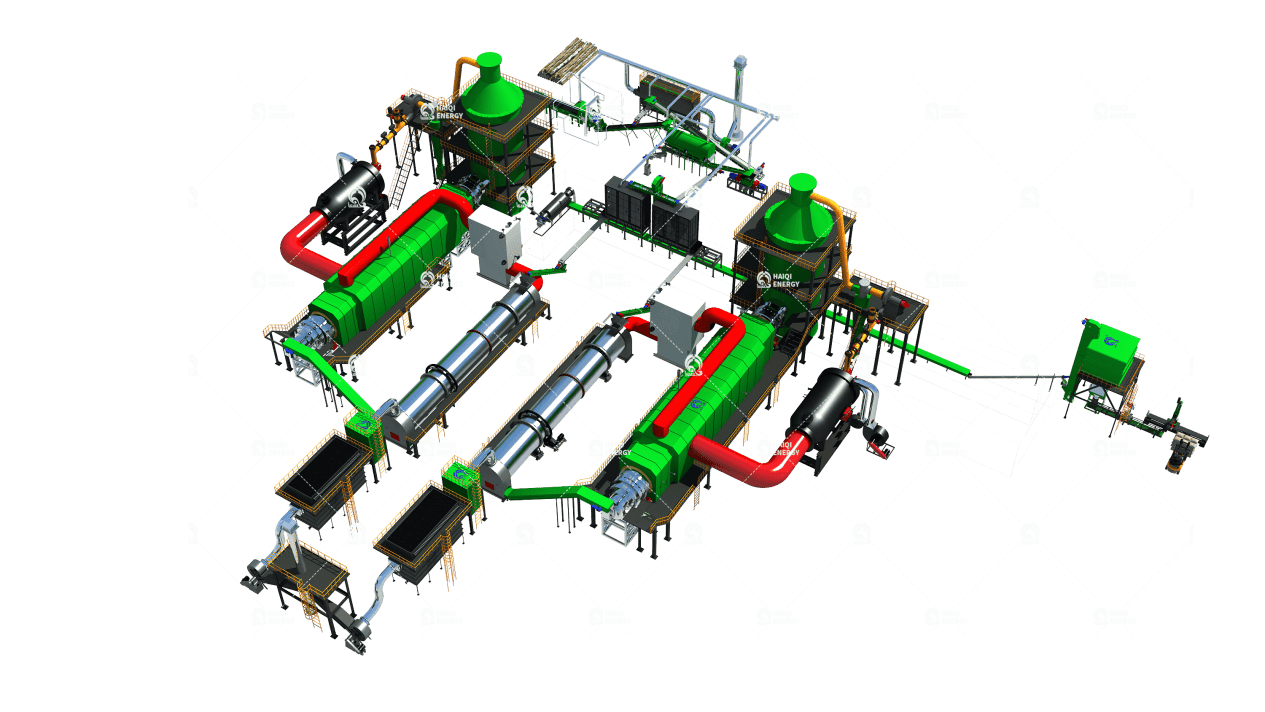
While this distinction is significant, it represents only one part of a commercial biochar production system. A complete system also encompasses feedstock preparation, drying, feeding, pyrolysis gas handling, biochar cooling, heat recovery, process control, and safety systems. Therefore, the choice of biochar pyrolysis equipment should not be based solely on the reactor type.
The screw conveyor is installed within a sealed processing chamber. As the shaft rotates, the biomass is continuously propelled forward through the reactor under controlled heating conditions. The system is designed to maintain a low-oxygen environment, allowing the biomass to undergo pyrolysis rather than conventional combustion.
During this process, the organic components of the biomass undergo thermal decomposition, yielding three main products: solid biochar, pyrolysis gas, and—depending on the process configuration and operating conditions—condensable products such as bio-oil or wood vinegar.
Beyond simply transporting biomass from one end of the reactor to the other, the screw conveyor performs other critical functions.
It enables controlled material transport and helps maintain continuous feeding and discharge processes. Its design, rotational speed, pitch, diameter, and construction can be tailored to the specific characteristics of the biomass and the required processing throughput.
A rotary kiln pyrolysis reactor utilizes a rotating cylindrical chamber to transport and mix biomass during the thermal conversion process.
Unlike screw-type reactors—where the reactor body remains stationary while an internal screw moves the material—the cylindrical body of a rotary kiln itself rotates. Biomass enters the pyrolysis furnace via a controlled feeding system, moves through the rotating chamber as the kiln turns, and eventually reaches the outlet. Depending on the design, the kiln can also be installed at a controlled incline to facilitate material movement.
The continuous movement of the biomass exposes it to the thermal environment inside the reactor. As the biomass passes through the processing zone, pyrolysis occurs, and the solid product is discharged from the outlet.
Rotary kiln systems are widely used in various thermal processing applications because their rotating chambers enable continuous material movement and mixing. In biomass pyrolysis applications, this reactor can be integrated with feeding, heating, gas recovery, cooling, and automation systems to form a complete, continuous biochar production line.
If your project operates on a small-to-medium scale and requires continuous feeding, pyrolysis, and discharge, a screw-type reactor is often a top choice.
Screw-type reactors use a rotating screw to drive material continuously through a stationary reaction chamber, effectively linking feeding, pyrolysis, and discharge into a seamless process. This configuration facilitates system integration for projects aiming to minimize manual labor, utilize PLC-based automatic control, and maintain 24-hour continuous operation.
Screw-type systems offer a compact, continuous solution, particularly for feedstocks with well-controlled particle sizes and moisture content—such as wood chips, sawdust, fruit shells, and agricultural residues.
Rotary kilns move material forward through the rotation of the cylindrical reactor body; the equipment size and process configuration can be tailored to the specific processing capacity. In industrial-scale projects, rotary kilns can be integrated with large-scale systems for feeding, heating, pyrolysis gas utilization, biochar cooling, and waste heat recovery.
However, "large-scale" does not mandate the use of a rotary kiln. Screw-type equipment can also be designed for industrial-scale applications. Therefore, the final choice should be based on an analysis of actual processing capacity, feedstock characteristics, and the overall plant process, rather than relying solely on the project scale.
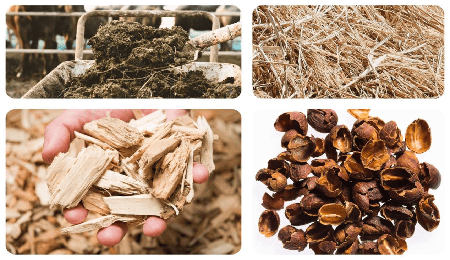
For instance, a project might simultaneously process wood chips, branches, fruit shells, or agricultural residues from various sources. These feedstocks can differ significantly in density, fiber structure, ash content, and flowability. In such cases, evaluation must extend beyond the reactor itself to include the crushing, screening, drying, conveying, and feeding systems.
In this scenario, the feedstock enters the reactor with stable material characteristics, allowing the feeding system to operate using relatively fixed parameters. The screw mechanism continuously conveys the material while the reactor maintains a stable pyrolysis environment, creating a continuous production process.
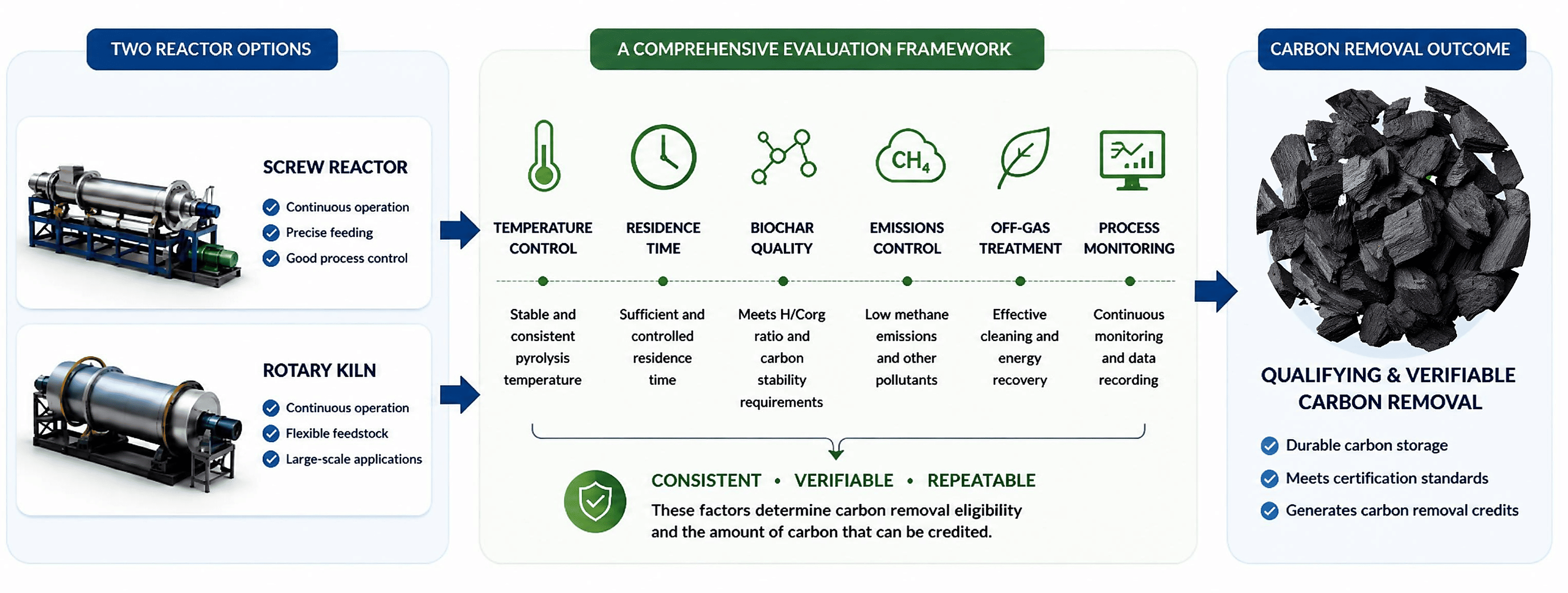
There is no single pyrolysis reactor type that is universally preferred for biochar carbon removal projects. Carbon removal standards and certification platforms generally do not require a project to use a specific reactor design, such as a screw reactor or a rotary kiln. Instead, the selected technology must demonstrate that it can consistently produce qualifying biochar and meet requirements for process control, emissions, carbon stability, and monitoring.
For carbon removal projects, the more important question is therefore not simply whether a reactor is a screw type or a rotary kiln, but whether the complete pyrolysis system can provide stable and verifiable operating conditions. Parameters such as pyrolysis temperature, residence time, feedstock characteristics, biochar H/Corg ratio, methane emissions, off-gas treatment, and continuous process monitoring can directly affect carbon removal eligibility and the amount of carbon that can ultimately be credited. Puro.earth, for example, has publicly assessed reactor designs based on their ability to produce biochar meeting the required H/Corg threshold and their risk of methane emissions, rather than approving a particular reactor geometry.
For a carbon removal project, the reactor itself is only one part of the certification equation; the ability of the entire production system to generate consistent, measurable, and durable carbon removal is what matters most.
Raw biomass may subsequently require size reduction and screening equipment. If moisture content is too high, drying is usually necessary prior to pyrolysis. Conveyors, hoppers, and controlled feeding mechanisms transport the processed biomass into the reactor.
The pyrolysis section comprises the reactor and its heating system. A gas handling system collects and conveys the pyrolysis gases generated during operation. Depending on the design, these gases can be combusted to provide process heat rather than simply being treated as a waste stream.
Following pyrolysis, the hot biochar enters a controlled cooling system. Once cooled, the material can be conveyed to storage, screening, grinding, pelletizing, packaging, or other downstream processing stages based on its intended use.
The plant may also include dust collection units, emissions control equipment, heat recovery systems, electrical systems, PLC control systems, monitoring instrumentation, and safety systems.
The key is that these systems must operate in concert; a biochar plant is far more than just a reactor connected to a conveyor belt.
During startup, the plant may require auxiliary fuel since insufficient pyrolysis gas is being produced. Once the system is operating stably, the generated gas can be routed to the heating system and combusted to supply process heat.
The yield and composition of pyrolysis gas depend heavily on the feedstock and operating conditions; therefore, one cannot assume that all biomass will produce identical quantities of usable gas.
The gas handling system must also be properly designed. Gas piping, valves, burners, monitoring instruments, combustion control systems, and safety systems must all work in coordination. The goal is not merely to collect the gas, but to integrate gas production and energy consumption into a stable thermal balance.
Biomass drying is one common application. Waste heat generated by the pyrolysis system can be transferred to the dryer, thereby reducing the external energy required to remove moisture from the feedstock.
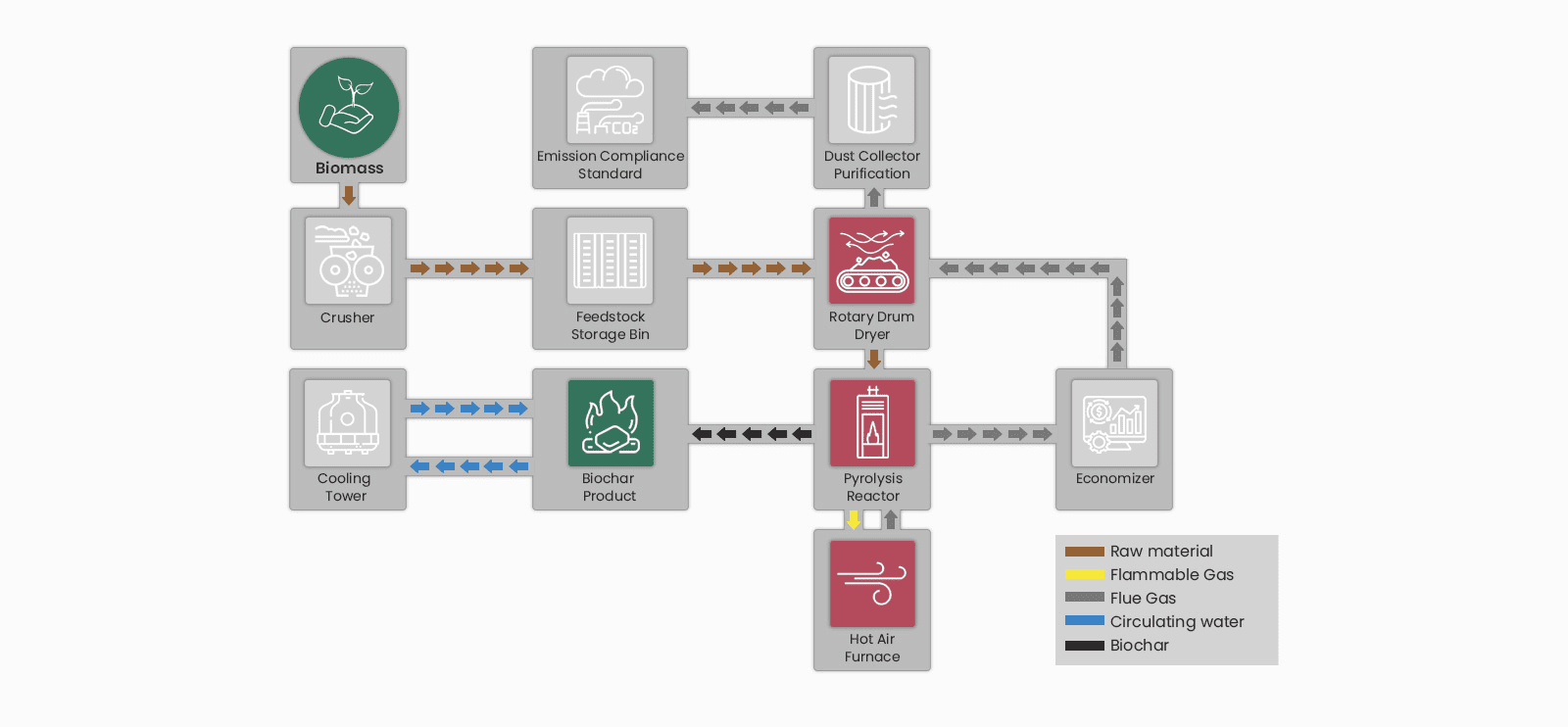
Depending on the project, recovered heat can also be used to generate hot air, hot water, or steam, or utilized in other industrial processes.
The appropriate waste heat recovery configuration depends on feedstock moisture content, plant capacity, available heat sources, required drying load, and the client's energy needs.
What are the main differences between rotary kiln and screw-type pyrolysis reactors?
The primary difference lies in how the biomass moves through the reactor. Screw-type reactors utilize a rotating screw within a stationary reaction chamber, whereas rotary kilns move the biomass by rotating the cylindrical reactor itself.
Can both reactor types be used for continuous biochar production?
Yes. Both screw-type and rotary kiln reactors can be designed for continuous biochar production. Continuous operation depends on the design of the entire plant, including feeding, reactor operation, gas handling, cooling, and control systems.
Does biomass require drying prior to pyrolysis?
If the feedstock moisture content is too high, drying is usually required. The appropriate target moisture level depends on the reactor and process design, but many industrial systems are designed for biomass with a moisture content below approximately 15%.
Can pyrolysis gas be reused as fuel of biochar equipment?
Yes. In a well-designed system, pyrolysis gas can be recovered and used as internal fuel. However, during startup, auxiliary fuel may still be required because the volume of pyrolysis gas generated is not yet sufficient.
Can a pyrolysis plant process different types of biomass materials?
Theoretically, a plant can process various biomass feedstocks, but this does not mean that every feedstock can be processed under identical conditions. Differences in moisture content, particle size, ash content, density, and thermal properties may necessitate adjustments to pretreatment or operating parameters.
The answer begins with how the biomass moves within the reactor. In a screw-type system, a rotating screw conveyor transports the biomass through a stationary reaction chamber. In contrast, with a rotary kiln, the reactor itself rotates, causing the biomass to move within the cylindrical chamber as the kiln turns.
While this distinction is significant, it represents only one part of a commercial biochar production system. A complete system also encompasses feedstock preparation, drying, feeding, pyrolysis gas handling, biochar cooling, heat recovery, process control, and safety systems. Therefore, the choice of biochar pyrolysis equipment should not be based solely on the reactor type.
What is a screw-type biochar pyrolysis reactor?
A screw-type biochar pyrolysis reactor is a continuous thermal conversion system in which biomass is transported into the pyrolysis reactor via a rotating screw shaft.The screw conveyor is installed within a sealed processing chamber. As the shaft rotates, the biomass is continuously propelled forward through the reactor under controlled heating conditions. The system is designed to maintain a low-oxygen environment, allowing the biomass to undergo pyrolysis rather than conventional combustion.
During this process, the organic components of the biomass undergo thermal decomposition, yielding three main products: solid biochar, pyrolysis gas, and—depending on the process configuration and operating conditions—condensable products such as bio-oil or wood vinegar.
Beyond simply transporting biomass from one end of the reactor to the other, the screw conveyor performs other critical functions.
It enables controlled material transport and helps maintain continuous feeding and discharge processes. Its design, rotational speed, pitch, diameter, and construction can be tailored to the specific characteristics of the biomass and the required processing throughput.
What is a rotary kiln biochar pyrolysis reactor?
A rotary kiln pyrolysis reactor utilizes a rotating cylindrical chamber to transport and mix biomass during the thermal conversion process.
Unlike screw-type reactors—where the reactor body remains stationary while an internal screw moves the material—the cylindrical body of a rotary kiln itself rotates. Biomass enters the pyrolysis furnace via a controlled feeding system, moves through the rotating chamber as the kiln turns, and eventually reaches the outlet. Depending on the design, the kiln can also be installed at a controlled incline to facilitate material movement.
The continuous movement of the biomass exposes it to the thermal environment inside the reactor. As the biomass passes through the processing zone, pyrolysis occurs, and the solid product is discharged from the outlet.
Rotary kiln systems are widely used in various thermal processing applications because their rotating chambers enable continuous material movement and mixing. In biomass pyrolysis applications, this reactor can be integrated with feeding, heating, gas recovery, cooling, and automation systems to form a complete, continuous biochar production line.
How to Choose the Right Pyrolysis Reactor for Your Project?
Small-to-Medium Scale, Continuous Projects: Consider Screw-Type Reactors
If your project operates on a small-to-medium scale and requires continuous feeding, pyrolysis, and discharge, a screw-type reactor is often a top choice.
Screw-type reactors use a rotating screw to drive material continuously through a stationary reaction chamber, effectively linking feeding, pyrolysis, and discharge into a seamless process. This configuration facilitates system integration for projects aiming to minimize manual labor, utilize PLC-based automatic control, and maintain 24-hour continuous operation.
Screw-type systems offer a compact, continuous solution, particularly for feedstocks with well-controlled particle sizes and moisture content—such as wood chips, sawdust, fruit shells, and agricultural residues.
High-capacity or industrial-scale projects: Consider rotary kiln reactors
For projects requiring large processing capacities and long-term, stable operation, the rotary kiln solution is a strong candidate for evaluation.Rotary kilns move material forward through the rotation of the cylindrical reactor body; the equipment size and process configuration can be tailored to the specific processing capacity. In industrial-scale projects, rotary kilns can be integrated with large-scale systems for feeding, heating, pyrolysis gas utilization, biochar cooling, and waste heat recovery.
However, "large-scale" does not mandate the use of a rotary kiln. Screw-type equipment can also be designed for industrial-scale applications. Therefore, the final choice should be based on an analysis of actual processing capacity, feedstock characteristics, and the overall plant process, rather than relying solely on the project scale.
Projects with diverse feedstocks or highly variable properties: Prioritize evaluating rotary kiln solutions
If a project involves processing multiple types of biomass, or if the feedstock exhibits significant variations in particle size, density, and physical form, the equipment's adaptability to these changes should be a key evaluation criterion.For instance, a project might simultaneously process wood chips, branches, fruit shells, or agricultural residues from various sources. These feedstocks can differ significantly in density, fiber structure, ash content, and flowability. In such cases, evaluation must extend beyond the reactor itself to include the crushing, screening, drying, conveying, and feeding systems.
Projects with thoroughly pre-treated feedstock: Consider screw-type solutions
If your feedstock source is stable and meets equipment specifications—such as low moisture content, uniform particle size, minimal foreign matter, and consistent daily supply—screw-type reactors are often highly suitable.In this scenario, the feedstock enters the reactor with stable material characteristics, allowing the feeding system to operate using relatively fixed parameters. The screw mechanism continuously conveys the material while the reactor maintains a stable pyrolysis environment, creating a continuous production process.
Which Pyrolysis Reactor Is Best for Biochar Carbon Removal Projects?
There is no single pyrolysis reactor type that is universally preferred for biochar carbon removal projects. Carbon removal standards and certification platforms generally do not require a project to use a specific reactor design, such as a screw reactor or a rotary kiln. Instead, the selected technology must demonstrate that it can consistently produce qualifying biochar and meet requirements for process control, emissions, carbon stability, and monitoring.
For carbon removal projects, the more important question is therefore not simply whether a reactor is a screw type or a rotary kiln, but whether the complete pyrolysis system can provide stable and verifiable operating conditions. Parameters such as pyrolysis temperature, residence time, feedstock characteristics, biochar H/Corg ratio, methane emissions, off-gas treatment, and continuous process monitoring can directly affect carbon removal eligibility and the amount of carbon that can ultimately be credited. Puro.earth, for example, has publicly assessed reactor designs based on their ability to produce biochar meeting the required H/Corg threshold and their risk of methane emissions, rather than approving a particular reactor geometry.
For a carbon removal project, the reactor itself is only one part of the certification equation; the ability of the entire production system to generate consistent, measurable, and durable carbon removal is what matters most.
What equipment is included in a commercial biochar pyrolysis plant?
Specific equipment configurations depend on the feedstock and project requirements, but commercial plants typically begin with feedstock receiving and storage systems.Raw biomass may subsequently require size reduction and screening equipment. If moisture content is too high, drying is usually necessary prior to pyrolysis. Conveyors, hoppers, and controlled feeding mechanisms transport the processed biomass into the reactor.
The pyrolysis section comprises the reactor and its heating system. A gas handling system collects and conveys the pyrolysis gases generated during operation. Depending on the design, these gases can be combusted to provide process heat rather than simply being treated as a waste stream.
Following pyrolysis, the hot biochar enters a controlled cooling system. Once cooled, the material can be conveyed to storage, screening, grinding, pelletizing, packaging, or other downstream processing stages based on its intended use.
The plant may also include dust collection units, emissions control equipment, heat recovery systems, electrical systems, PLC control systems, monitoring instrumentation, and safety systems.
The key is that these systems must operate in concert; a biochar plant is far more than just a reactor connected to a conveyor belt.
Can pyrolysis gas be reused as fuel of biochar equipment?
Yes. In a well-designed pyrolysis system, the gases generated during biomass pyrolysis can be recovered and reused as an internal energy source.During startup, the plant may require auxiliary fuel since insufficient pyrolysis gas is being produced. Once the system is operating stably, the generated gas can be routed to the heating system and combusted to supply process heat.
The yield and composition of pyrolysis gas depend heavily on the feedstock and operating conditions; therefore, one cannot assume that all biomass will produce identical quantities of usable gas.
The gas handling system must also be properly designed. Gas piping, valves, burners, monitoring instruments, combustion control systems, and safety systems must all work in coordination. The goal is not merely to collect the gas, but to integrate gas production and energy consumption into a stable thermal balance.
How does a biochar plant utilize waste heat?
Substantial heat is required for biomass drying and for maintaining the conditions necessary for pyrolysis. Rather than letting this useful thermal energy go to waste, it is better to design a system capable of recovering heat from the relevant process.Biomass drying is one common application. Waste heat generated by the pyrolysis system can be transferred to the dryer, thereby reducing the external energy required to remove moisture from the feedstock.
Depending on the project, recovered heat can also be used to generate hot air, hot water, or steam, or utilized in other industrial processes.
The appropriate waste heat recovery configuration depends on feedstock moisture content, plant capacity, available heat sources, required drying load, and the client's energy needs.
FAQs regarding rotary kiln and screw-type biochar pyrolysis equipment
What are the main differences between rotary kiln and screw-type pyrolysis reactors?
The primary difference lies in how the biomass moves through the reactor. Screw-type reactors utilize a rotating screw within a stationary reaction chamber, whereas rotary kilns move the biomass by rotating the cylindrical reactor itself.
Can both reactor types be used for continuous biochar production?
Yes. Both screw-type and rotary kiln reactors can be designed for continuous biochar production. Continuous operation depends on the design of the entire plant, including feeding, reactor operation, gas handling, cooling, and control systems.
Does biomass require drying prior to pyrolysis?
If the feedstock moisture content is too high, drying is usually required. The appropriate target moisture level depends on the reactor and process design, but many industrial systems are designed for biomass with a moisture content below approximately 15%.
Can pyrolysis gas be reused as fuel of biochar equipment?
Yes. In a well-designed system, pyrolysis gas can be recovered and used as internal fuel. However, during startup, auxiliary fuel may still be required because the volume of pyrolysis gas generated is not yet sufficient.
Can a pyrolysis plant process different types of biomass materials?
Theoretically, a plant can process various biomass feedstocks, but this does not mean that every feedstock can be processed under identical conditions. Differences in moisture content, particle size, ash content, density, and thermal properties may necessitate adjustments to pretreatment or operating parameters.
Next Article: